
Moisture Movement
To be able to inspect for moisture intrusion and related problems, a homeowner should understand the basics of how moisture can move through a house.
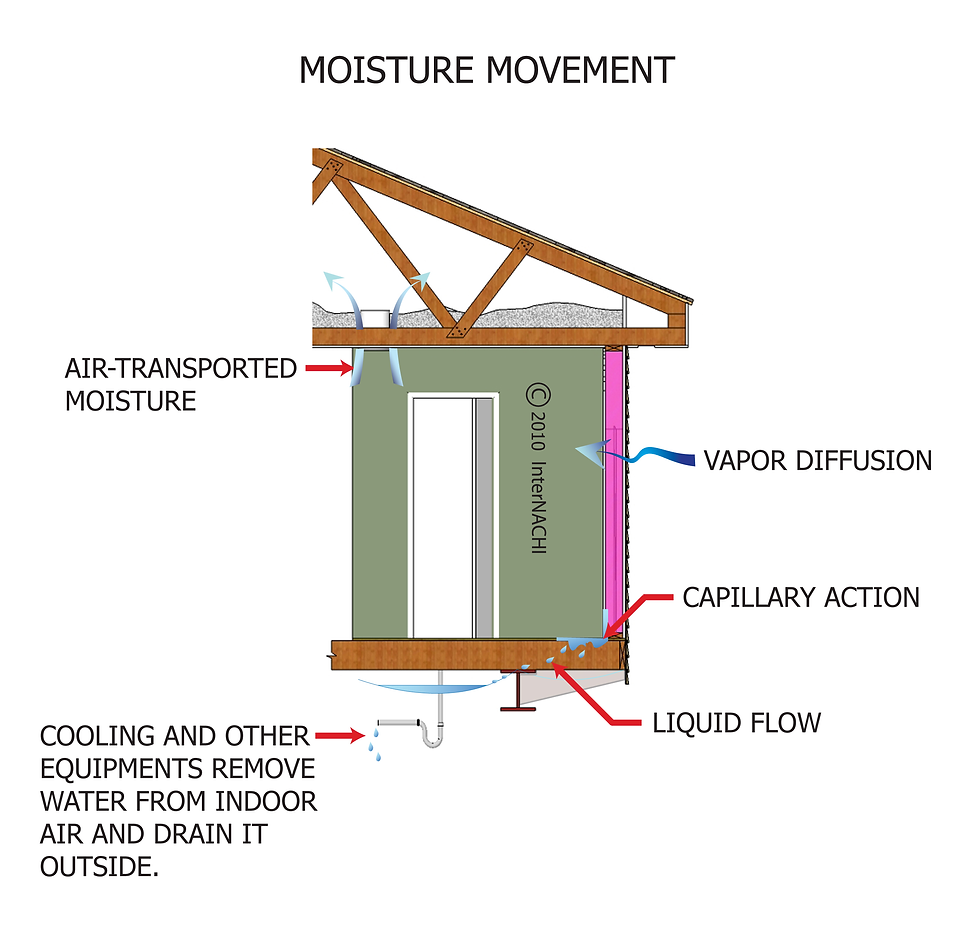
Understanding Moisture Movement
Moisture and water vapor move in and out of a house in three ways:
with air currents;
by diffusion through materials; and
by heat transfer.
Of these three, air movement accounts for more than 98% of all water vapor movement in building cavities. Air naturally moves from a high-pressure area to a lower one by the easiest path possible — generally, through any available hole or crack in the building envelope.
Moisture transfer by air currents is very fast — in the range of several hundred cubic feet of air per minute. Thus, to control air movement, a house should have any unintended air paths thoroughly and permanently sealed.
Second Law of Thermodynamics

Moisture flow by vapor diffusion is also governed by the second law of thermodynamics (thanks, Rudolf Clausius and Lord Kelvin!), whereby moisture will flow because of a concentration and temperature gradient (from high-to-low and from more-to-less). And that means moisture tends to move in cold climates from the inside outward, and in warmer climates from the outside inward.

Moisture transfer by air currents happens quickly, and carefully and permanently air-sealing any unintended paths for air movement in and out of the house is a very effective moisture control strategy.

The other two driving forces — diffusion through materials, and heat transfer — are much slower processes. Most common building materials slow moisture diffusion to a large degree, although they never stop it completely. Insulation also helps reduce heat transfer or flow.
The laws of physics govern how moist air reacts within various temperature conditions. The study of the properties of moist air is technically referred to as psychrometrics. Psychrometrics is the science that measures the relationship between air temperature and moisture content. It helps home inspectors predict where condensation will form and understand how humidity behaves in buildings. A psychrometric chart is used by professionals to determine at what temperature and moisture concentration water vapor begins to condense. This is called the dew point. By learning how to determine the dew point, you will better understand how to diagnose moisture problems in a house.
Relative humidity (RH) refers to the amount of moisture contained in a quantity of air compared to the maximum amount of moisture the air could hold at the same temperature. As air warms, its ability to hold water vapor increases; this capacity decreases as air cools.
For example, according to the psychrometric chart, air at 68º F (20º C) with 0.216 ounces of water (H2O) per pound of air (14.8g H2O/kg air) has 100% RH. The same air at 59º F (15º C) reaches 100% RH with only 0.156 ounces of water per pound of air (10.7g H2O/kg air). The colder air holds about 28% less moisture than the warmer air does. Warm air carries more water vapor than cold air. The moisture that the air can no longer hold condenses on the first cold surface it encounters – the dew point. If this surface is within an exterior wall cavity, the result will be wet insulation and framing.
In addition to air movement, one can also control temperature and moisture content. Since insulation reduces heat transfer (or flow), it also moderates the effect of temperature across the building envelope cavity. In most climates, properly installed vapor diffusion-retarders can be used to reduce the amount of moisture transfer. Except in deliberately ventilated spaces, such as attics, insulation and vapor diffusion-retarders work together to reduce the opportunity for condensation to form in a house's ceilings, walls and floors.
Permission granted by InterNachi https://www.nachi.org/


Comments